

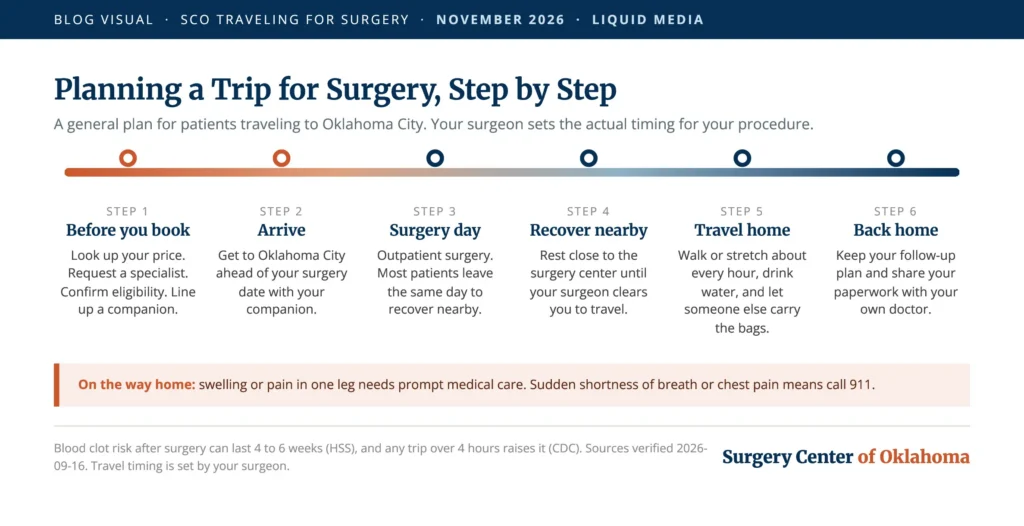
Traveling for surgery goes smoothly when you settle three things before you book a flight: what the surgery will cost, whether you’re a good candidate, and how long you’ll need to stay afterward. At Surgery Center of Oklahoma, most procedures are outpatient and every published price covers the surgeon, the facility, and anesthesia, so you know the number before you pack a bag. Bring a companion, plan to stay near Oklahoma City until your surgeon clears you, and follow their guidance on flying home, because the risk of blood clots after surgery lasts for weeks, not days.
Why people travel to Oklahoma City for surgery
Most people who travel to us are doing the same math. A hospital near home can’t tell them what surgery will cost until the bills arrive, and those bills come from the surgeon, the facility, and the anesthesiologist separately. We publish one all-inclusive price for every procedure on our Surgery Pricing page, and it’s the same whether you have insurance or not.
We’re a physician-owned outpatient surgery center, which means no hospital overhead built into your price. Since opening in 1997 we’ve raised prices only once, to adjust for inflation. You can read more about how that works on our About page.
For a lot of patients, a few hundred miles in the car or a short flight costs less than the gap between a published price and a hospital estimate that won’t settle for months.
Before you book travel: a checklist
Sort these out before you buy a plane ticket or reserve a hotel. Each one can change your dates.
- Find your price. Look up your procedure on our Surgery Pricing page. Quotes are valid for 60 days, which gives you room to plan the trip.
- Request a specialist. Use our Request a Specialist form to get matched with a surgeon. If you don’t have a preference, we’ll pick an appropriate surgeon from our staff.
- Check that you’re eligible. For safety, we maintain a BMI limit of 50. If you’re traveling from outside the area, talk with our team about eligibility before you make any travel arrangements.
- Ask what isn’t included. The published price covers the surgeon, facility, and anesthesia. A few things fall outside it, such as implants for certain orthopedic procedures, an optional overnight stay, and the $250 consultation fee if the surgeon decides you aren’t a candidate. Our Pricing Disclaimer lists the exceptions.
- Line up a companion. Every patient needs a companion to take them to and from the surgery center. Plan for that person to stay with you for at least the first 24 hours.
- Plan your payment. Cashier’s checks or cash are preferred, and credit and debit cards are accepted. Payments go to Atlas Billing Company, except the consultation fee, which is paid at the surgeon’s office.
- Book flexible travel. Choose refundable or changeable tickets and lodging in case your surgeon wants you to stay a little longer.
How long should you plan to stay?
It depends on the procedure, and your surgeon makes the final call. Because our procedures are outpatient, most patients leave the surgery center the same day, so you’ll recover at a hotel or a friend’s home nearby rather than in a hospital bed.
For smaller procedures, many patients head home within a few days. For bigger operations, plan on a longer stay: the CDC’s guidance on traveling for medical care suggests delaying air travel for 10 to 14 days after major surgery. Ask your surgeon for a realistic range for your specific procedure before you book return travel.
If you’d rather not go straight back to a hotel, overnight stays at the surgery center aren’t usually necessary but can be arranged for an additional charge, with room for one family member.
Flying after surgery: what to know
Surgery raises your risk of a blood clot in the legs (deep vein thrombosis), and sitting still for a long trip adds to it. According to Hospital for Special Surgery, there’s a general risk of clotting for up to four to six weeks after surgery, and long flights make it worse. The CDC notes that any trip longer than four hours, by plane, car, bus, or train, can raise clot risk.
So the answer to “how long after surgery can you fly” isn’t one number. Your surgeon will look at the procedure, how you’re healing, and how long your trip home is. Once you’re cleared, these habits help:
- Get up and walk the aisle about once an hour, or pump your ankles and flex your calves in your seat.
- Drink plenty of water and skip alcohol before and during the flight.
- Wear compression stockings if your surgeon recommends them.
- Book an aisle seat so it’s easy to move.
- Don’t lift heavy bags. Check your luggage or ask for help with the overhead bin.
- Keep your medications and discharge instructions in your carry-on, not your checked bag.
Driving home counts too. If it’s a long drive, stop every hour or two to get out and walk, and let your companion do the driving.
Warning signs on the way home
Most trips home are uneventful, but know what to watch for:
- Swelling, pain, warmth, or redness in one calf or leg can be a sign of a blood clot. Get medical care right away.
- Sudden shortness of breath, chest pain, or coughing up blood can mean a clot has traveled to the lungs. Call 911.
- Fever, bleeding that won’t slow down, or a wound that’s getting redder or draining should prompt a call to your surgeon’s office.
Follow-up care after you get home
Routine follow-up care is part of our published price. Before you leave Oklahoma City, make sure you know who to call with questions, when your follow-up check is, and how it will happen once you’re home. It’s also smart to let your primary care doctor know about your surgery and share your discharge paperwork, so someone local has the full picture.
Will insurance pay for surgery in another state?
Sometimes, but it depends on your plan. Many insurance plans treat a facility in another state as out of network, which can leave you with a higher deductible or no coverage at all. Our published price doesn’t depend on insurance, so a lot of patients simply pay it directly, sometimes with money from a health savings account.
If your health coverage comes through an employer that pays its own claims (a self-funded plan), ask your HR department. Some self-funded plans already work with Surgery Center of Oklahoma and may be able to make other payment arrangements.
Frequently Asked Questions
How long after surgery can you fly?
It depends on the procedure and how you’re healing, so your surgeon makes the call. The CDC suggests waiting 10 to 14 days after major surgery, and the risk of blood clots can last four to six weeks, so smaller procedures may allow travel sooner than bigger ones. Get clearance before you book return flights.
Is it safer to drive home after surgery instead of flying?
Not automatically. Any trip longer than about four hours, by car or plane, can raise the risk of blood clots. If you drive, stop every hour or two to walk, stay hydrated, and have your companion drive.
Do I need someone with me when I travel for surgery?
Yes. Every patient at Surgery Center of Oklahoma needs a companion to take them to and from the surgery center, and it’s best to have that person stay with you for at least the first 24 hours.
Can I stay overnight at Surgery Center of Oklahoma after surgery?
Overnight stays usually aren’t necessary because our procedures are outpatient, but they can be arranged for an additional charge, and there’s room for one family member to stay with you.
How long is my surgery price good for if I’m planning a trip?
Quotes are valid for 60 days. Our prices rarely change: since 1997 we’ve raised them only once, to adjust for inflation.
Will insurance pay for surgery out of state?
It depends on your plan. Many plans treat out-of-state facilities as out of network. Our published price is the same with or without insurance, and some self-funded employer plans work with us directly, so check with your HR department.
Ready to plan your surgery trip?
Start by finding your procedure and its all-inclusive price on our Surgery Pricing page. When you’re ready, request a specialist and our team will help you work out the timing.